Colour and Sound Facts
¡A Simple Explanation!
It's all about waves... and particles
Light and sound behave as waves; it is the nature of these phenomena.
The light frequency range for the visible spectrum on human is 420THz to 680THz.
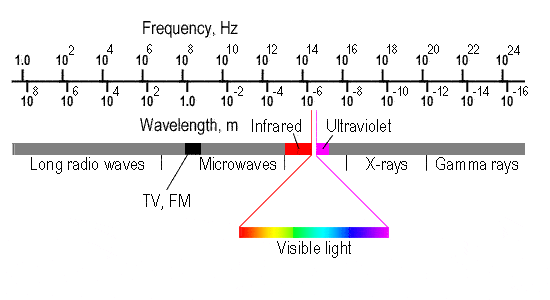
We can’t hear sound at these frequencies as our hearing range goes from 20Hz to 20KHz, far behind from THz.
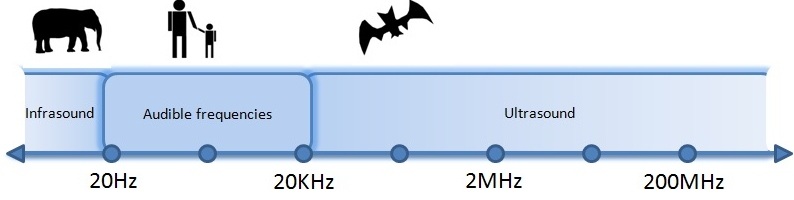
But if we could hear the red colour it’ll sound as a note between F and F# on a higher octave: the 44th. In the same way, if we could hear the yellow colour, it’ll sound similar to a G, and so on.
So we could bring these notes from the 44th octave to a perceptible one, say the 4th:

Note: Below the F# sound of red, there would be a light frequency which sounds like F... but this infrared colour is imperceptible for us, so we represent it by the rose colour. And the same goes for the ultraviolet colour frequency which sounds like E, and it's represented by the magenta colour.
Now, what about the other notes?, those higher and lower octaves?
Well, the colour has another dimension, such as the lightness; higher octaves correspond to more white on the basic colours… and lower octaves with more amount of black.
Take a look on the F note on different octaves, 2, 4 and 6.
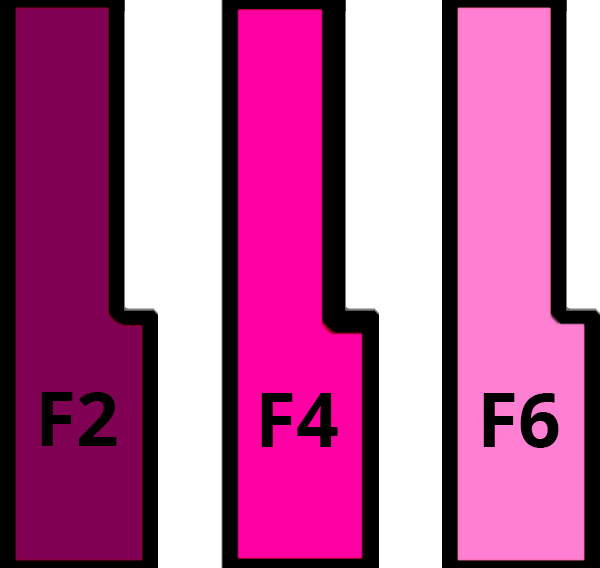
So this is our coloured piano:

You could perceive the musical notes as a colour spiral:
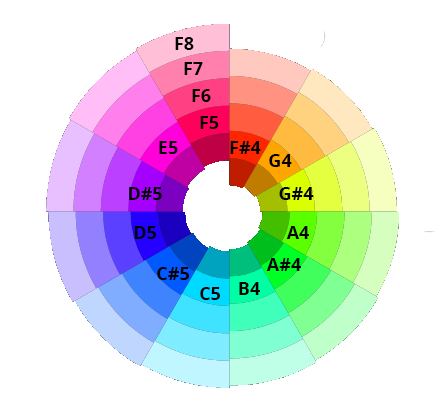
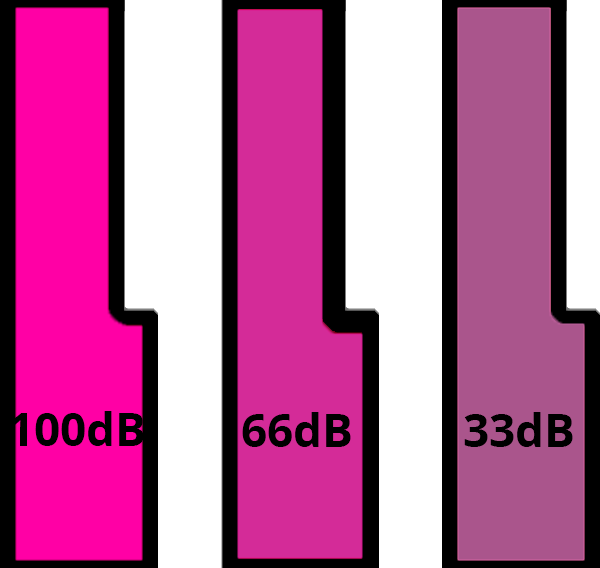
And finally, the intensity on the volume (DB), corresponds to the intensity of the light, this is, the level of greyness.
This project is intended to become a new instrument where you play by colours
... among other things like giving colour to a melody.
Note: the wave behavior of light exists in the electromagnetic "world" (though some theories refer to the light as a wave-particle duality, but this is another story). The sound waves are physical!
¡Please Enjoy!
Email for comments: andres.mendoza.o@gmail.com
Tested FireFox. Since February 2016, Chrome restricts User Media to certified sites, so webcam and mic are not available on this platform. Mobile version won't implement Web Audio Api analysers so the tracks should be loaded in memory (delay). Warning for headphone users!